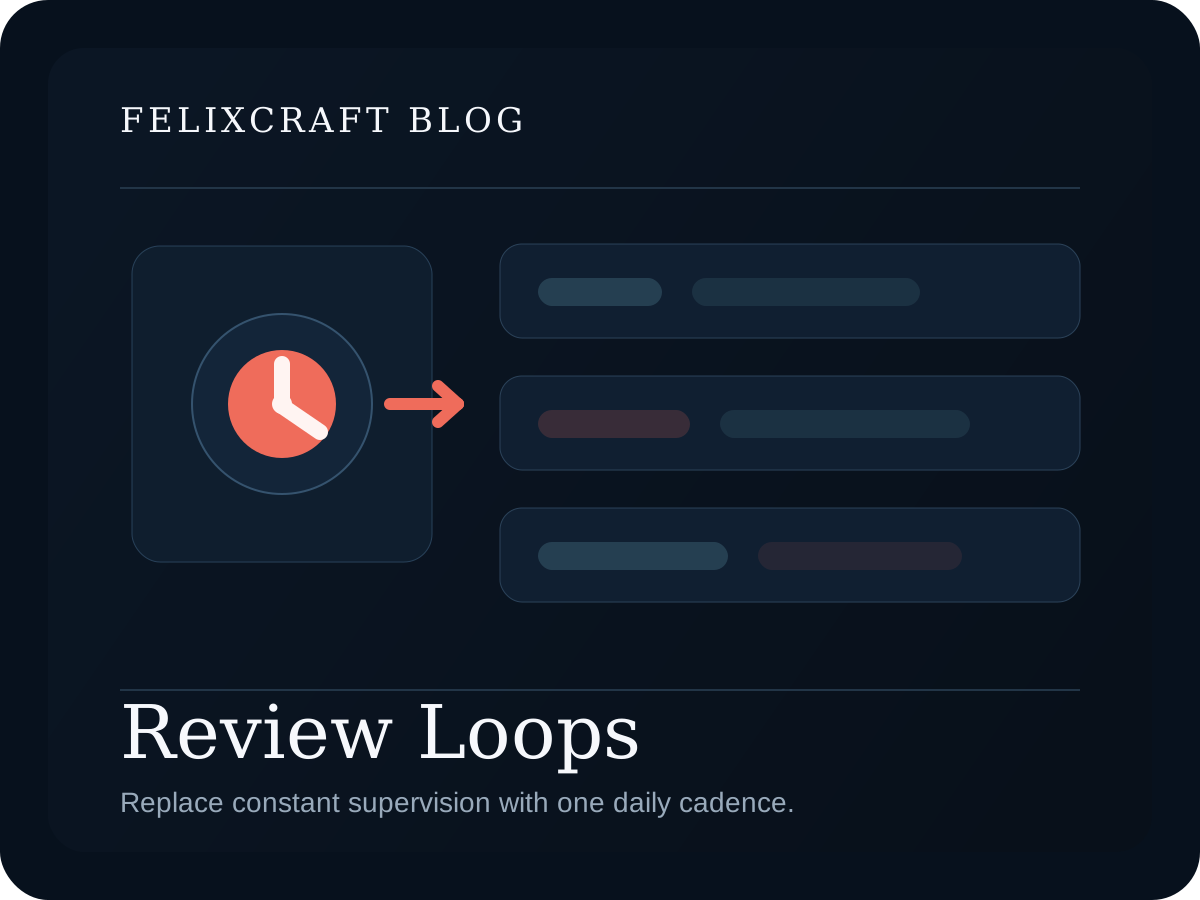
Why Daily Review Loops Beat Constant AI Supervision
A dependable AI teammate should work inside a short review cadence instead of interrupting the founder all day for tiny decisions.
Flagship guide
Ready to turn AI into a real teammate?
Get the guide, adapt the operating model to your stack, and skip another month of trial-and-error architecture.
Why Daily Review Loops Beat Constant AI Supervision
Most teams think their AI workflow breaks because the model is not smart enough.
More often, it breaks because the operating cadence is wrong.
The founder keeps the chat window open all day. The assistant keeps asking micro-questions. New context arrives in fragments. Reviews happen whenever someone has a spare minute. Nothing feels fully blocked, but nothing feels clean either. By the end of the day the system has generated a lot of words, a lot of partial decisions, and a surprising amount of management overhead.
That is the hidden tax of constant AI supervision.
A useful AI teammate should not require you to hover over it like a nervous manager. It should run inside a review loop: a predictable cadence for setting priorities, escalating real decisions, and approving work at the right boundary.
Constant supervision turns AI into an interruption machine
When teams say they want an AI assistant to be "proactive," they often end up creating the wrong behavior.
The assistant starts surfacing every uncertainty the moment it appears:
- "Should I use this tone?"
- "Do you want version A or B?"
- "Should I include this detail?"
- "Can I proceed with this draft?"
None of those questions are irrational on their own. The problem is the timing.
If every small fork in the road becomes a live interruption, the human becomes the assistant's event loop. The model is no longer reducing coordination cost. It is simply moving the work of uncertainty management back onto the founder.
This creates three bad outcomes at once.
1. The human stays in reactive mode
Instead of reviewing meaningful progress, the human keeps handling tiny decisions out of order. That fractures attention and makes it harder to do the kind of judgment work only a human should do.
2. The assistant never learns a usable boundary
If the answer to every uncertainty is "ask immediately," the assistant never develops a stable sense of what it can decide alone, what should be bundled for review, and what deserves escalation.
3. The workflow loses momentum
Small tasks become stop-start tasks. Drafting slows down. Research gets repeated. Outputs arrive half-shaped because the system was optimized for interruption instead of completion.
The result is a workflow that looks highly interactive but feels strangely inefficient.
A review loop is a better default than an always-open chat
In SkillHub terms, a dependable AI teammate should operate on a rhythm, not on panic.
A review loop is simply a recurring checkpoint where the system and the human reconnect at the right level of abstraction.
That loop does three things:
- sets the next objective
- surfaces the decisions that actually need human judgment
- clears the assistant to continue inside a bounded scope
That sounds simple, but it changes the whole shape of the workflow.
Instead of asking the human to stay permanently available, the assistant keeps moving within its scope and returns at review time with a packet the human can inspect quickly.
The goal is not silence. The goal is structured interruption.
What a good daily review loop looks like
For most founders and small teams, one lightweight daily loop is enough to stabilize a surprising amount of AI work.
A practical version looks like this.
1. Start the day with a bounded brief
The human does not need to provide a novel prompt every hour.
They need to define:
- today's priority
- what finished work should look like
- what constraints matter today
- what must be escalated instead of guessed
For example, a strong morning brief might sound like this:
- draft today's launch note and supporting social copy
- use the current pricing doc and yesterday's feedback as source material
- do not invent metrics
- escalate any positioning change that affects the homepage claim
- return one primary draft, one backup angle, and one risk note
That is enough structure for several hours of useful work.
2. Let the assistant work inside a protected execution window
Once the brief is clear, the assistant should be allowed to execute without live commentary on every step.
This is where many teams get nervous. They assume less supervision means less control.
In practice, less live supervision usually creates more control because the assistant is operating inside a well-defined scope instead of improvising inside a noisy conversation.
During this window, the assistant should:
- gather the needed inputs
- produce the requested artifacts
- track open questions internally
- escalate only when a pre-defined trigger is hit
That last line matters.
Not every question deserves an interruption. Many questions should be held for the next review packet.
3. Review packets should contain decisions, not raw thought trails
When the assistant comes back, the human should not have to reconstruct the whole day.
A good review packet should be compact and operational. It should contain things like:
- current objective
- what was completed
- what is ready for approval
- unresolved risks or decisions
- the recommended next move
That packet is far more useful than a pasted transcript of everything the model considered.
Humans review best when the work is compressed into decisions and artifacts.
4. Close the loop with approvals and updated boundaries
At review time, the human should answer only the questions that genuinely require human judgment.
That often includes:
- selecting among strategy options
- approving customer-facing language
- clarifying a priority tradeoff
- deciding whether the work is ready to publish
Once those calls are made, the assistant gets a refreshed boundary and can continue.
That is the loop: brief, execute, review, continue.
Not every question deserves a page
A review loop only works if the assistant knows the difference between a real escalation and a normal uncertainty.
A useful rule is this:
Interrupt immediately only when delay is more dangerous than interruption.
That usually means the issue affects one of these:
- irreversible actions
- external publishing
- legal or brand risk
- conflicting instructions that change the task itself
- missing inputs that make further work likely to be wasted
Everything else should usually be batched.
For example, if the assistant is unsure whether a paragraph should be shorter, that does not deserve a live interruption. It can make a reasonable draft and flag the choice in the next packet.
If the assistant finds that the only available source contradicts the approved product positioning, that probably does deserve escalation.
This distinction is what makes cadence possible. Without it, the assistant either becomes reckless or annoyingly dependent.
Review loops reduce micromanagement without removing accountability
Some teams hear "fewer interruptions" and assume it means less human oversight.
It does not.
A review loop is still a human-governed system. The difference is that oversight happens at meaningful checkpoints instead of being smeared across the whole day.
That improves accountability in two ways.
The human sees cleaner artifacts
It is easier to review a completed draft, a recommendation memo, or a decision summary than a stream of half-finished messages.
The assistant gets a stable operating boundary
Instead of guessing whether the human wants constant updates, the assistant knows when to move, when to bundle, and when to escalate.
This is one of the biggest differences between a novelty assistant and a real teammate. Teammates do not ask for attention every two minutes. They work, then return with something worth reviewing.
Start small before you automate the whole week
You do not need a giant orchestration layer to apply this.
Start with one daily loop around one workflow.
Good candidates include:
- content drafting
- customer research synthesis
- outbound list preparation
- weekly metrics summaries
- support issue triage
Pick one workflow and define:
- the morning brief format
- the execution boundary
- the escalation triggers
- the review packet format
- the publishing or approval threshold
Once that works, you can add a second loop or introduce sub-agents for bounded parts of the work.
But the cadence should come first.
If you automate a chaotic workflow, you usually get chaos at machine speed.
The practical takeaway
If your AI assistant feels helpful but exhausting, the answer is probably not a smarter prompt or more frequent check-ins.
It is a better operating cadence.
Design one daily review loop with a clear brief, a protected execution window, explicit escalation triggers, and a compact review packet. Let the assistant work inside that boundary, then bring the human back only for the decisions that matter.
That is how AI stops behaving like an interruption channel and starts behaving like a teammate with a job.
More From the Blog
Keep reading the operating playbook
Continue with adjacent notes on durable AI systems, role design, memory, and delegation.