Why AI Workflows Need a Source-of-Truth Hierarchy Before More Context
If your assistant sees every doc, draft, and chat fragment as equally authoritative, more context will make the work less reliable instead of more useful.
Flagship guide
Ready to turn AI into a real teammate?
Get the guide, adapt the operating model to your stack, and skip another month of trial-and-error architecture.
Why AI Workflows Need a Source-of-Truth Hierarchy Before More Context
Most AI workflow problems do not start with too little context.
They start with too much unranked context.
A team gives the assistant a product spec, a launch brief, a few old homepage drafts, scattered chat instructions, yesterday's meeting notes, and a half-finished Notion page. Then it asks for a clean output and acts surprised when the result feels slightly off. The model did not ignore the context. It used all of it. That is exactly the problem.
When every source looks equally important, the assistant has no stable way to decide what should win.
That is why many teams keep adding context and keep getting inconsistent outputs. The issue is not only retrieval. It is authority.
A dependable AI teammate needs a source-of-truth hierarchy before it needs more context.
More context does not help when precedence is unclear
There is a common belief that AI quality improves if you simply provide more material.
Sometimes that is true. Often it is not.
If the assistant receives five inputs that disagree with each other, adding a sixth input does not create clarity. It usually creates a noisier conflict surface. The model starts blending sources that should never have been blended.
That is how you get outputs like these:
- a landing page draft that mixes current positioning with last quarter's messaging
- an internal memo that treats a brainstorm comment like a policy decision
- a customer reply that quotes an old pricing rule because it happened to be in the loaded context
- a blog post that sounds vaguely right but smuggles in claims from outdated notes
These failures are often misdiagnosed as hallucinations.
Many are actually hierarchy failures.
The assistant was given multiple sources, but nobody told it which source outranks which other source. So it did the only thing a model can do in that situation: it synthesized across them.
That feels intelligent in low-risk drafting. It becomes dangerous when the work depends on policy, product truth, or publishing standards.
SkillHub framing: context should have authority lanes
In SkillHub terms, context is not just memory. It is an operating surface.
A good operating surface does not only answer, "What information is available?" It also answers, "What information wins when there is a conflict?"
That is the job of a source-of-truth hierarchy.
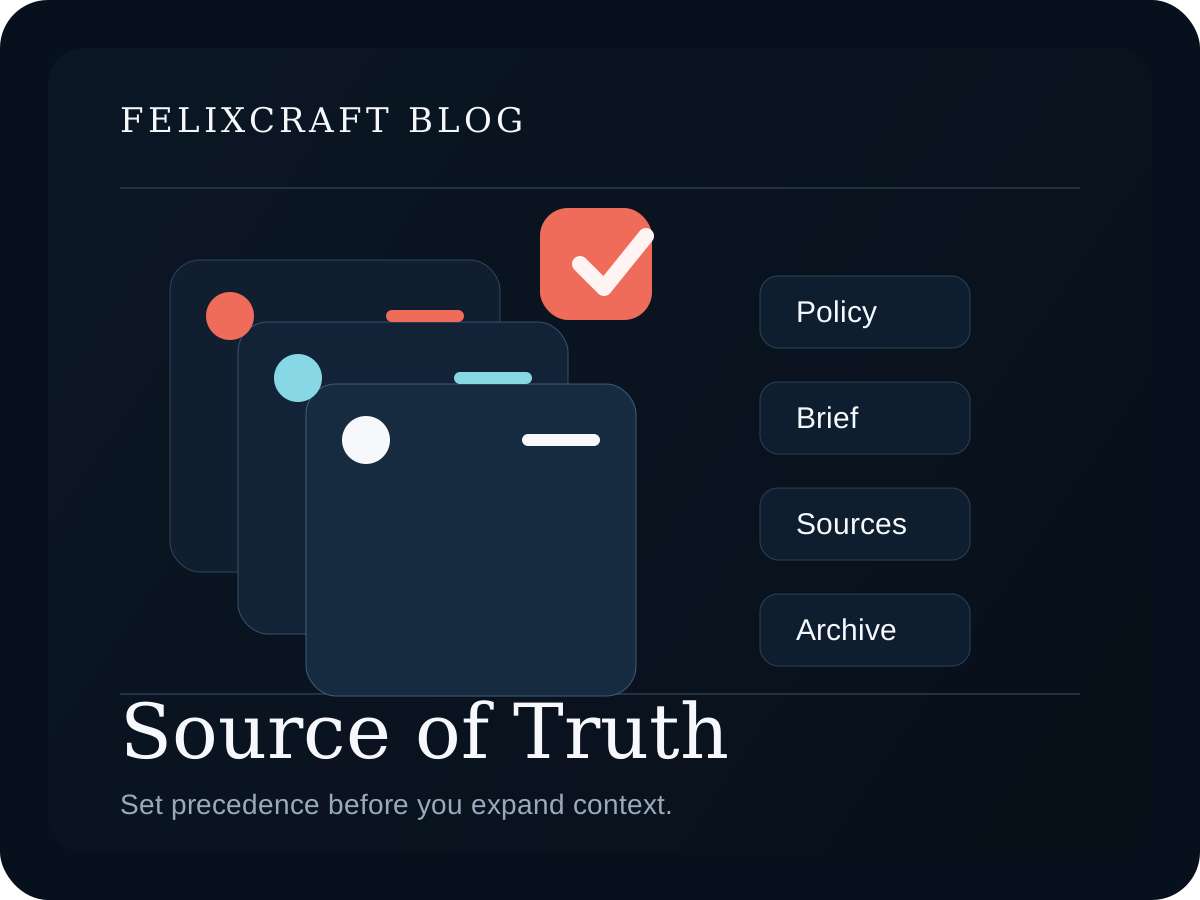
A hierarchy gives the assistant a stable rule for resolving tension between inputs. It defines which materials are foundational, which ones are task-specific, which ones are provisional, and which ones should be treated as reference-only.
Without that structure, the assistant keeps doing expensive guesswork. With that structure, it can move faster because it has a dependable order of trust.
The key principle is simple:
Freshness and visibility are not the same thing as authority.
A recent chat message may be newer than the product positioning doc. That does not automatically mean it should override the positioning doc. A draft in progress may be closer to the current task than the brand guide. That does not mean the brand guide stopped mattering.
The system needs a rule.
A practical five-layer hierarchy
You do not need a giant governance framework to make this useful.
For most founder and small-team workflows, a simple five-layer model is enough.
1. Role and policy sources
This is the durable top layer.
It includes the materials that define the assistant's job, boundaries, and standards:
- role definitions
- safety rules
- publishing rules
- approval requirements
- trusted operating playbooks
These sources answer questions like:
- What is this assistant allowed to do?
- What must it escalate?
- What standard counts as done?
- Which surfaces are read-only, draft-only, or release-gated?
This layer should change slowly. If it changes constantly inside ad hoc conversation, the assistant will never develop stable behavior.
2. Current task brief
This is the active assignment layer.
It contains the current objective, constraints, success criteria, and known escalation rules for the task at hand. Examples include:
- today's launch brief
- the requested deliverable format
- the relevant deadline
- the current audience or channel
- what should be flagged instead of guessed
This layer does not replace role and policy sources. It operates inside them.
A good task brief can narrow the work sharply, but it should not silently grant new authority that the policy layer never allowed.
3. Approved reference materials
This layer includes the documents the assistant should use to ground factual or strategic claims for the current task.
Examples:
- the current pricing page copy
- the approved product spec
- the updated messaging document
- the support FAQ
- a reviewed research summary
These are the sources that should drive the substance of the output.
If the assistant is writing a blog post, an outbound note, or a recommendation memo, this is the layer that keeps the content anchored to reality.
4. Working artifacts
This layer contains in-progress material generated during the workflow:
- partial drafts
- earlier versions
- notes from the current session
- extracted snippets
- comparison tables
Working artifacts are useful, but they should usually sit below approved reference material.
Why? Because drafts tend to inherit mistakes, temporary assumptions, and unresolved choices. If a working artifact starts outranking approved material by accident, the assistant begins treating provisional thinking as settled truth.
That is how drift enters the system.
5. Archive and retrieval-only context
This is the bottom layer.
It includes older notes, past decisions, old experiments, previous campaigns, and any material that might provide background but should not silently drive current outputs.
Archive material is still valuable. It helps the assistant understand history, prior patterns, and lessons learned.
But it should generally answer, "What happened before?" not, "What should we say now?"
If archived material conflicts with the active brief or approved references, the archive should lose unless a human explicitly says otherwise.
The hierarchy only works if conflicts are explicit
Many teams assume the assistant will somehow infer the right precedence by tone or proximity.
That is unreliable.
A real hierarchy needs clear conflict rules.
For example:
- policy beats task convenience
- the current approved brief beats an old draft
- reviewed product docs beat brainstorm notes
- approved sources beat model-generated summaries
- archive material can inform, but not override
These rules matter because conflicts are not edge cases. They are normal.
A content operator may see an old customer interview that uses language the team has since abandoned. A support assistant may find a legacy internal note that contradicts the live help center. A product drafting agent may inherit a thread where three humans changed direction halfway through.
If the system does not know which layer wins, it will often merge them into a polished but unstable answer.
That is worse than a visible question mark because the output looks coherent while carrying the wrong assumption.
Use escalation when the top layers disagree
A hierarchy is not there to eliminate judgment. It is there to decide when judgment is required.
The most important escalation case is not "I found missing context."
It is:
"I found conflicting high-authority context."
That deserves review.
For example, the assistant should stop and surface the issue when:
- the task brief conflicts with a standing publishing rule
- the product spec conflicts with the latest approved messaging doc
- two approved reference sources disagree on a customer-facing claim
- the human request would require breaking a policy boundary
In those cases, the assistant should not smooth over the contradiction and keep moving. It should present a small review packet:
- which sources conflict
- which layer each source belongs to
- what decision is blocked
- what the recommended resolution is
That makes the escalation fast and inspectable.
It also prevents the common failure mode where the model quietly picks the source that is easiest to satisfy in the moment.
This is what makes delegation safer
A source-of-truth hierarchy is not only a writing improvement. It is a delegation primitive.
Sub-agents and long-running operators become much more reliable when they inherit a ranked input model instead of one big pile of context.
That changes the quality of delegation in three ways.
It reduces accidental drift
The assistant is less likely to treat temporary notes as policy or old outputs as live truth.
It improves review
When something looks wrong, the human can inspect the source layer instead of re-reading the entire transcript.
It makes handoffs cleaner
A sub-agent can be told not only what sources to use, but how to rank them. That is much more useful than saying, "Use your judgment," when the judgment rule was never actually defined.
This is one of the hidden differences between a demo workflow and an operational one. Demo workflows assume the model can reconcile messy inputs on its own. Operational workflows define the order of trust ahead of time.
Start with one workflow, not the whole company
You do not need to redesign every knowledge surface at once.
Start where AI work is already creating friction.
Good places to begin include:
- blog publishing
- customer support drafting
- product announcement preparation
- sales research summaries
- internal weekly brief generation
For one workflow, write down:
- the top policy sources
- the active brief format
- the approved references
- the working artifacts that are allowed
- the archive materials that are reference-only
- the escalation rule when top layers disagree
That alone will make the assistant feel more dependable because it no longer has to invent a trust model on the fly.
The practical takeaway
If your current instinct is to keep stuffing more material into the context window, stop for a minute.
Ask a better question:
What should this assistant trust first?
Once that order is explicit, more context can become useful again.
Until then, extra context is often just extra ambiguity with better formatting.
A real AI teammate does not only need access to information. It needs a stable hierarchy for deciding which information gets to drive the work.
More From the Blog
Keep reading the operating playbook
Continue with adjacent notes on durable AI systems, role design, memory, and delegation.