Why AI Teammates Need Stop Conditions Before Better Planning
An AI operator that only knows the goal will keep churning; stop conditions tell it when to hand work back, escalate risk, and end the run cleanly.

Flagship guide
Ready to turn AI into a real teammate?
Get the guide, adapt the operating model to your stack, and skip another month of trial-and-error architecture.
Why AI Teammates Need Stop Conditions Before Better Planning
A lot of AI workflow advice assumes the main problem is planning.
Write a better brief. Add more context. Create a smarter task tree. Give the agent better tools.
Those things matter.
But many workflows do not fail because the assistant lacked a plan. They fail because the assistant never knew when to stop.
An operator with a goal but no stop conditions will keep moving long after the useful boundary of the task. It will keep searching after the answer is already good enough. It will keep drafting after the decision point has already been reached. It will keep trying to resolve conflicts that should have been handed back for review.
That is why more planning alone does not make an AI teammate dependable.
A dependable AI teammate needs stop conditions: explicit rules for when execution ends, when control changes hands, and when the system should escalate instead of continuing.
The common mistake is defining ambition without an exit
Many teams are now pretty good at defining what they want.
They can say things like:
- research the market and prepare a recommendation
- draft the launch post from these notes
- clean up the backlog and flag high-priority issues
- keep moving until the output is ready to ship
What is often missing is the second half of the contract.
Questions like these stay implicit:
- How much research is enough?
- What kind of uncertainty should trigger review?
- At what point does the assistant stop polishing and return a draft?
- When does the task become too risky to continue without a human?
- How many failed attempts count as a signal to stop instead of retrying again?
When those rules are missing, the model fills the gap with momentum.
That is not a sign of intelligence. It is just what generative systems do when the goal is open-ended. They keep generating moves that seem locally useful.
The result looks like effort, but the workflow gets distorted.
You see it when an agent keeps collecting examples long after the pattern is obvious. You see it when a drafting assistant rewrites the same paragraph four times instead of returning the version that is already reviewable. You see it when a workflow tries to reconcile contradictory source material rather than pausing to surface the conflict.
In all of those cases, the problem is not a lack of planning. It is a missing stop rule.
SkillHub framing: stop conditions are part of the role, not a footnote
In SkillHub terms, a role is not complete when you define only mission, inputs, and outputs.
A real operator also needs to know the handoff boundary.
That boundary answers three practical questions:
- When should the assistant declare the task complete?
- When should the assistant return a review artifact instead of continuing alone?
- When should the assistant stop because the workflow has crossed into uncertainty, conflict, or risk?
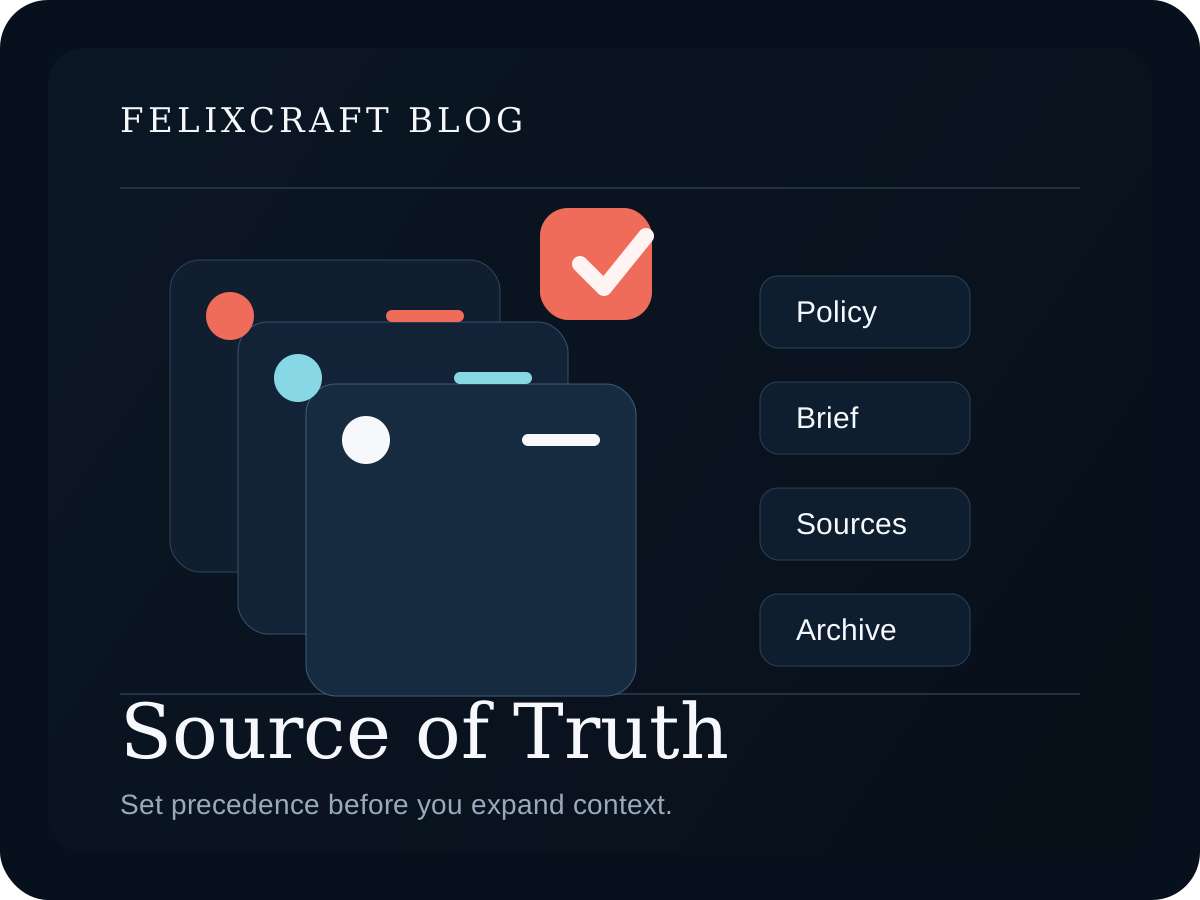
This is why stop conditions belong beside role design, source-of-truth hierarchy, and review thresholds.
They are not a tiny implementation detail. They are part of the operating contract.
A goal tells the assistant what direction to move.
A stop condition tells it when movement should end.
Without that second part, teams accidentally reward endless motion. The assistant appears proactive because it keeps doing something, but the system becomes harder to inspect. Humans do not know whether the extra work improved the result, hid a conflict, or simply delayed the moment when review should have happened.
That is a bad trade.
Goals and stop conditions solve different problems
It helps to separate the two.
Goals define what success looks like
A good goal might say:
- produce a publish-ready first draft
- identify the top five recurring objections
- prepare a recommendation memo with one primary path
That is useful because it points the workflow in the right direction.
Stop conditions define when the assistant should hand back control
A good stop condition might say:
- stop when the draft meets the output template and return it for review
- stop when two approved sources disagree on a customer-facing claim
- stop after one full pass if remaining edits are stylistic rather than structural
- stop after two failed tool attempts and surface the blocker
That is useful because it prevents the assistant from treating every unfinished possibility as a reason to continue.
The combination matters.
A workflow with stop conditions but no goal becomes timid and fragmented.
A workflow with a goal but no stop conditions becomes restless and overextended.
A dependable AI teammate needs both.
Four stop conditions most operators should have
You do not need an elaborate governance system to make this practical.
For most founder and small-team workflows, four stop conditions create most of the value.
1. Completion stop
This is the simplest one.
It defines the artifact that is good enough to hand back.
Examples:
- return when the draft matches the requested structure and all claims come from approved sources
- return when the comparison table is complete and each vendor has the required fields
- return when the issue triage list includes owner, severity, and next action
This stop matters because many assistants keep working simply because more work is technically possible.
A completion stop says: the job is not "do more." The job is "produce the agreed artifact."
2. Uncertainty stop
This condition protects the workflow from confident drift.
Examples:
- stop if the best available sources conflict at the same authority level
- stop if a factual claim cannot be verified from approved references
- stop if the brief is ambiguous enough that two different outputs would both seem reasonable
This is the stop condition that keeps the assistant from smoothing over contradictions just to stay useful.
A good operator should not always ask for help at the first unknown. But it also should not quietly convert uncertainty into polished guesswork.
3. Risk stop
This condition defines where autonomy ends because the consequence of being wrong rises sharply.
Examples:
- stop before anything customer-facing is published
- stop before modifying production data
- stop before changing pricing, policy, or brand claims
- stop before sending external communication on behalf of the team
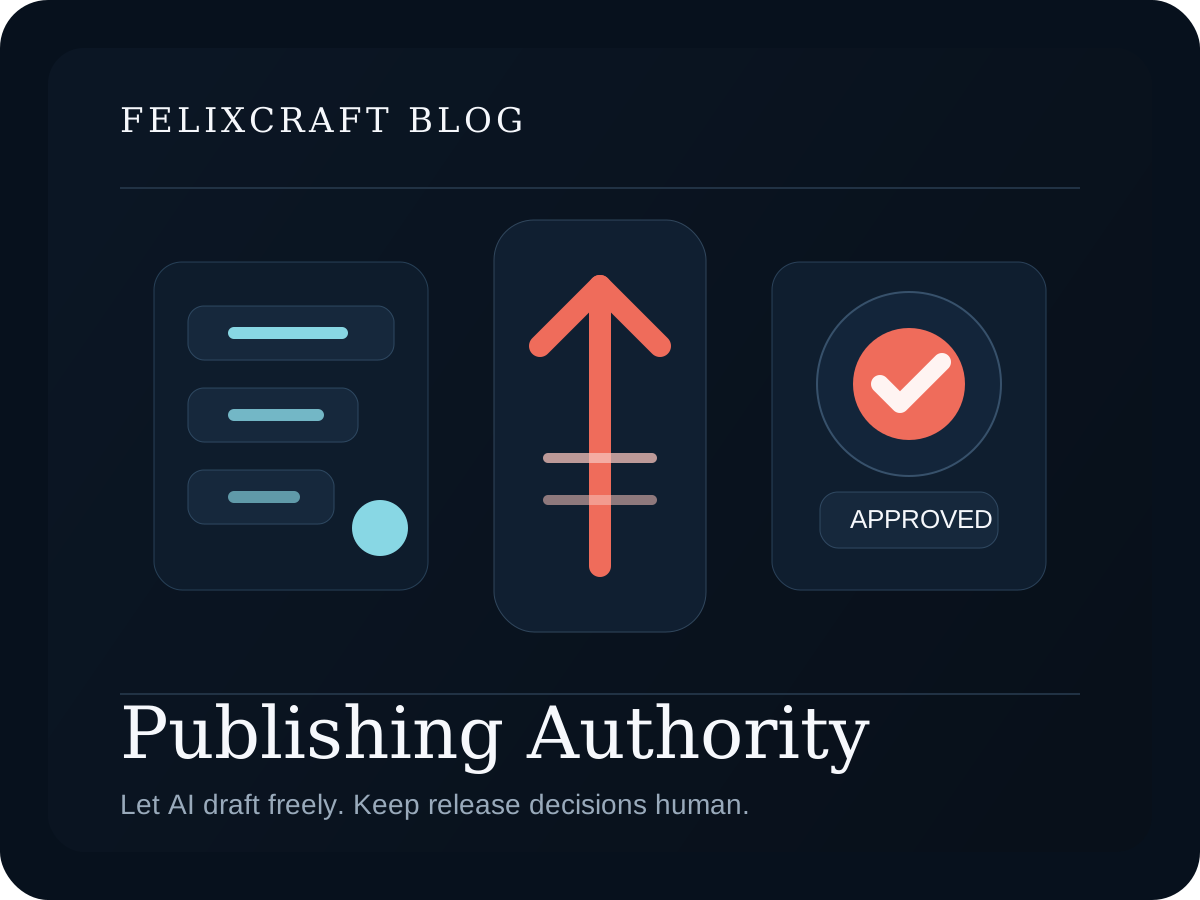
This does not make the assistant less useful. It makes the workflow trustworthy.
Low-risk execution can stay fast because the high-risk boundary is explicit.
4. Effort stop
This condition prevents loops, retries, and over-polishing.
Examples:
- stop after two failed attempts with the same tool
- stop after one rewrite pass if the remaining changes are cosmetic
- stop after the assigned research budget is used
- stop after thirty minutes and return the best artifact plus open questions
This matters more than people think.
A lot of AI systems do not fail in dramatic ways. They fail by quietly consuming too much time for too little improvement. An effort stop protects throughput.
What bad stop design looks like in practice
Once you start looking for it, missing stop conditions show up everywhere.
Endless research loops
The assistant keeps gathering examples because nobody said how much evidence is enough to make a recommendation.
Premature self-resolution
The assistant finds conflicting source material and tries to blend it into one answer because nobody defined uncertainty as a reason to stop.
Hidden over-polishing
The draft gets marginally cleaner, but review is delayed because the assistant keeps chasing a nicer version instead of returning the one that already satisfies the brief.
Tool retry spirals
A workflow keeps hitting the same blocked dependency, but there is no effort stop, so the system keeps attempting variations of the same move.
These are not rare edge cases. They are normal outcomes when the workflow only specifies intent and never specifies exit.
A simple stop-condition template for founders and small teams
If you want a lightweight default, attach this checklist to any recurring AI workflow:
1. Define the goal
What artifact should come back?
2. Define the review threshold
What class of decision must return to a human?
3. Define the uncertainty stop
What conflicts or missing evidence should pause execution?
4. Define the effort stop
How many retries, revisions, or minutes are allowed before the assistant should stop?
5. Define the completion signal
What exact condition means the work is ready to hand back?
That is enough to make many workflows feel dramatically more controlled.
You do not need to predict every possible failure. You just need to tell the assistant when continued motion stops being the right move.
Stop conditions make delegation cleaner
This is especially important when work is delegated to sub-agents or long-running operators.
Without stop conditions, delegation expands uncertainty. The sub-agent keeps going because it inherited a target but not a boundary. The main operator then receives a bloated result, a hidden conflict, or an unclear explanation of why the run took so long.
With stop conditions, the handoff gets sharper.
A bounded delegation packet can say:
- analyze these five sources
- return one recommendation memo
- stop if the sources disagree on the core claim
- stop after two failed retrieval attempts
- do not continue into publishing or external actions
Now the delegated work is inspectable.
The sub-agent does not need to improvise a theory of when to stop. The system already defined it.
That is one of the quiet differences between orchestration theater and real AI operations. Real operations define exit rules ahead of time.
The practical takeaway
If your AI workflow feels busy but not reliably useful, do not only improve the brief.
Improve the exit.
Define what the assistant is trying to produce, but also define when it should stop, when it should return control, and when it should escalate instead of pushing through.
A real AI teammate is not the system that keeps moving the longest. It is the one that knows the exact point where execution should end and human judgment should take over.
More From the Blog
Keep reading the operating playbook
Continue with adjacent notes on durable AI systems, role design, memory, and delegation.