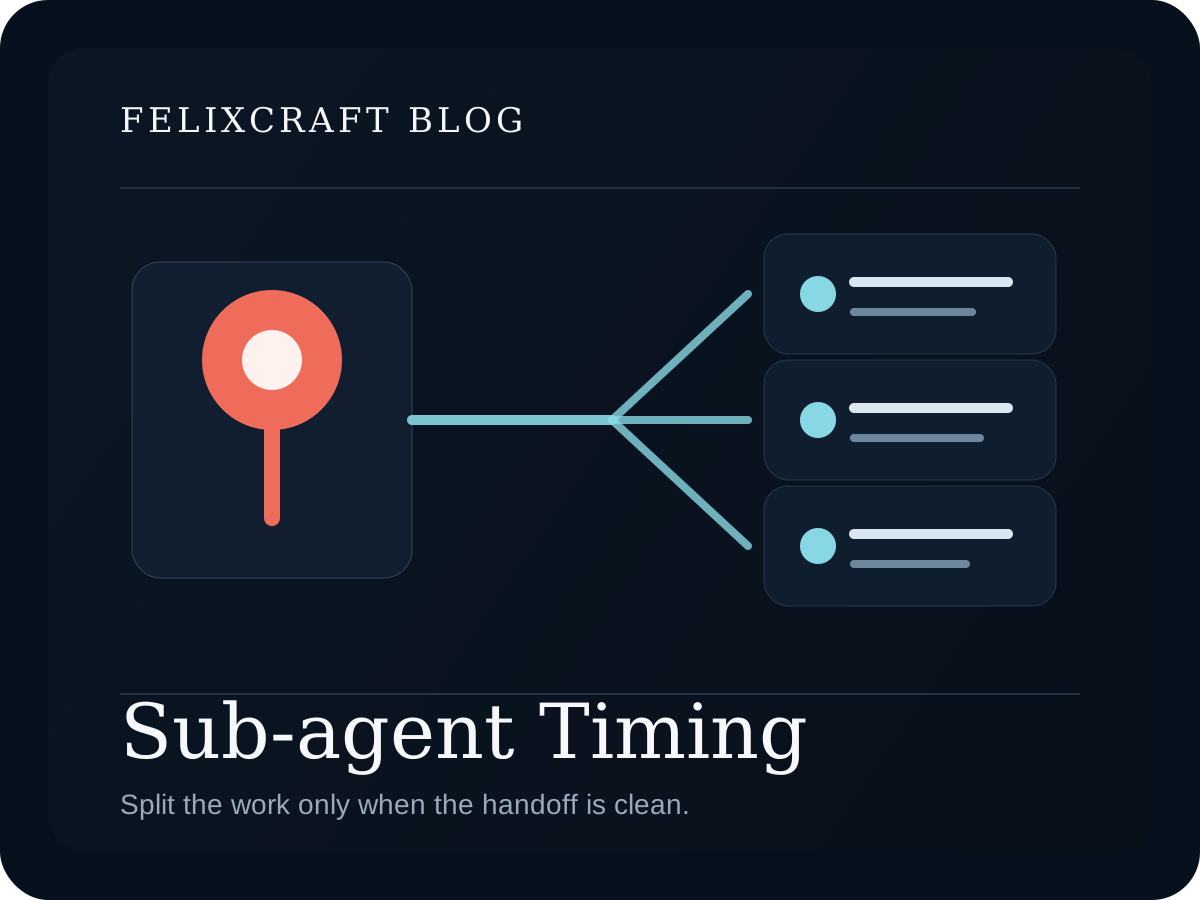
When to Use Sub-Agents and When One Operator Should Keep the Thread
Most teams delegate too early; the better system keeps one accountable operator until the work can be split with clean handoffs.
Flagship guide
Ready to turn AI into a real teammate?
Get the guide, adapt the operating model to your stack, and skip another month of trial-and-error architecture.
When to Use Sub-Agents and When One Operator Should Keep the Thread
Most teams do not have an autonomy problem.
They have a decomposition problem.
As soon as an AI workflow feels messy, the instinct is to add more agents. One agent researches. One drafts. One reviews. One summarizes. One formats. Very quickly the system looks sophisticated, but the work gets slower, blurrier, and harder to trust. Nobody is fully accountable for the outcome because the thread was split before the job was actually ready to split.
That is the core mistake: sub-agents are not a substitute for a clear operator.
A strong AI system usually needs one accountable thread owner first. Only after the work has a clean boundary should you spin off sub-agents.
More agents do not fix a fuzzy task
There is a common pattern behind bad delegation.
A founder gives an assistant a broad objective such as "figure out our onboarding problem" or "prepare everything for tomorrow's launch." The assistant has partial context, unclear success criteria, and a moving target. Instead of tightening the brief, the team adds more agents and hopes specialization will create clarity.
It usually creates the opposite.
Now each agent inherits a different slice of context. One agent optimizes for speed, another for completeness, another for polish. Handoffs become guesswork. Review gets harder because the reasoning is scattered across multiple threads. The system looks busy, but the quality does not reliably go up.
Sub-agents help when the work is already structured. They do not create structure on their own.
Start with the operator, not the swarm
In SkillHub terms, an operator is the thread that keeps responsibility.
That operator does not have to do every piece of work personally. But it does need to own four things:
- the current objective
- the standard of done
- the decision about when to delegate
- the final synthesis back into one coherent result
This matters because most real work contains judgment continuity.
If a task is still evolving, still being reframed, or still mixing discovery with decision-making, one persistent operator is usually the right shape. That thread can hold the live context, notice contradictions, and adjust the plan without paying constant handoff costs.
A good default is simple:
Keep one operator on the thread until the work can be described as a bounded assignment with a clear return artifact.
If you cannot describe the handoff cleanly, the sub-agent will not magically understand it better than the primary operator does.
When one operator should keep the thread
Use one persistent operator when the work depends on continuity more than parallelism.
That usually includes situations like these:
1. The brief is still changing
If the task is still being clarified, splitting it early just multiplies ambiguity.
The operator should stay on the thread, ask the narrowing questions, and turn the vague objective into a stable brief before delegating anything.
2. The task mixes judgment and synthesis
Some work cannot be cleanly separated into independent pieces.
Examples:
- shaping positioning for a landing page
- deciding what to include in a founder memo
- choosing the right tradeoff in a product proposal
- preparing a publish-ready narrative from messy source material
These jobs are not only about generating parts. They depend on one coherent point of view. A persistent operator is better suited to protect that coherence.
3. Review cost is higher than execution cost
If the human reviewer must reconstruct five different agent decisions to approve the output, the system is upside down.
In that case, it is usually faster to keep one operator thread and have it produce a single reviewable artifact.
4. The work depends on live context that changes during execution
When new facts are arriving, priorities are shifting, or the human is steering in real time, sub-agents can easily work off stale assumptions. One operator can absorb updates without spawning cleanup work later.
When sub-agents actually help
Sub-agents become powerful once the work has clean edges.
The sign to look for is not "this task is large." The sign is "this task can be separated without losing meaning."
That usually means three conditions are true.
1. The assignment is bounded
A bounded assignment has a clear question, scope, and finish line.
Good examples:
- extract objections from 40 sales calls and return the top 8 patterns
- audit a docs section for broken links and produce a fix list
- compare three competitors against a fixed rubric
- draft three subject-line variants for a defined campaign angle
These are strong sub-agent tasks because the agent can leave the main thread, do focused work, and come back with something inspectable.
2. The return artifact is explicit
A sub-agent should not come back with "thoughts."
It should come back with something the operator can use immediately:
- a table
- a shortlist
- a recommendation memo
- a diff
- a structured summary
- a risk list
The clearer the return artifact, the more useful the delegation.
3. The operator does not need the full reasoning path in real time
If the operator only needs the result plus key rationale, delegation works well.
If the operator needs to continuously steer the intermediate thinking, you probably do not have a real sub-agent task yet. You have one task that still belongs in the main thread.
Delegation needs a handoff contract
The practical difference between useful sub-agents and noisy ones is usually the handoff contract.
A handoff contract should answer five questions:
- What exactly are you solving?
- What inputs are in scope?
- What is out of scope?
- What artifact should come back?
- What should trigger escalation instead of guessing?
Without that contract, teams call it delegation when they are really just opening more windows.
For example, "research this market" is weak.
A stronger handoff is:
- analyze five competitor homepages
- use positioning clarity, offer structure, and proof density as the rubric
- ignore pricing pages and technical docs
- return a comparison table plus three reusable patterns
- escalate if the competitors serve visibly different audiences
That is delegation the operator can actually trust.
Use sub-agents to reduce cognitive load, not to hide complexity
This is where many AI stacks go wrong.
They use sub-agents as a way to avoid hard system design decisions. Instead of deciding what the main operator should own, they spread the ambiguity around and call it orchestration.
A better principle is:
Delegate to reduce cognitive load on the main operator, not to conceal an undefined workflow.
That means sub-agents should remove well-scoped work such as extraction, comparison, draft generation, or verification. They should not absorb the core responsibility for deciding what the task even is.
If the main operator still cannot explain the plan after spawning helpers, the system was decomposed too early.
A simple operating ladder
If you want a lightweight rule, use this ladder.
Stage 1: Keep it in one operator thread
Do this while:
- the objective is still being clarified
- the output standard is still moving
- the work requires one narrative owner
- human steering is frequent
Stage 2: Split off bounded sub-tasks
Delegate when:
- the brief is stable
- the task has a clean scope
- the return artifact is known
- the operator can review the result quickly
Stage 3: Re-synthesize in the operator thread
The operator should merge the outputs, resolve conflicts, and decide what actually moves forward.
This last step is important. A swarm of agents is not the product. The final integrated result is the product.
The review threshold still belongs to the operator
Even in a delegated system, publishing authority should not drift by accident.
Sub-agents can draft findings, generate options, or run checks. The operator should still decide when the work is complete enough to hand to a human or complete enough to ship inside the allowed boundary.
That is how you keep delegation aligned with trust.
The operator owns the review threshold. Sub-agents expand throughput inside that threshold.
Once you separate those roles, autonomy gets much easier to reason about.
The practical takeaway
Do not ask, "How many agents should this workflow have?"
Ask a better question:
Which part of this job still needs one accountable thread, and which part is finally clean enough to delegate?
Keep one operator where judgment continuity matters. Spawn sub-agents only when the assignment has a stable boundary and a clear return artifact.
That is how AI delegation stops feeling like orchestration theater and starts behaving like a real teammate system.
More From the Blog
Keep reading the operating playbook
Continue with adjacent notes on durable AI systems, role design, memory, and delegation.