How to Separate Drafting Autonomy From Publishing Authority
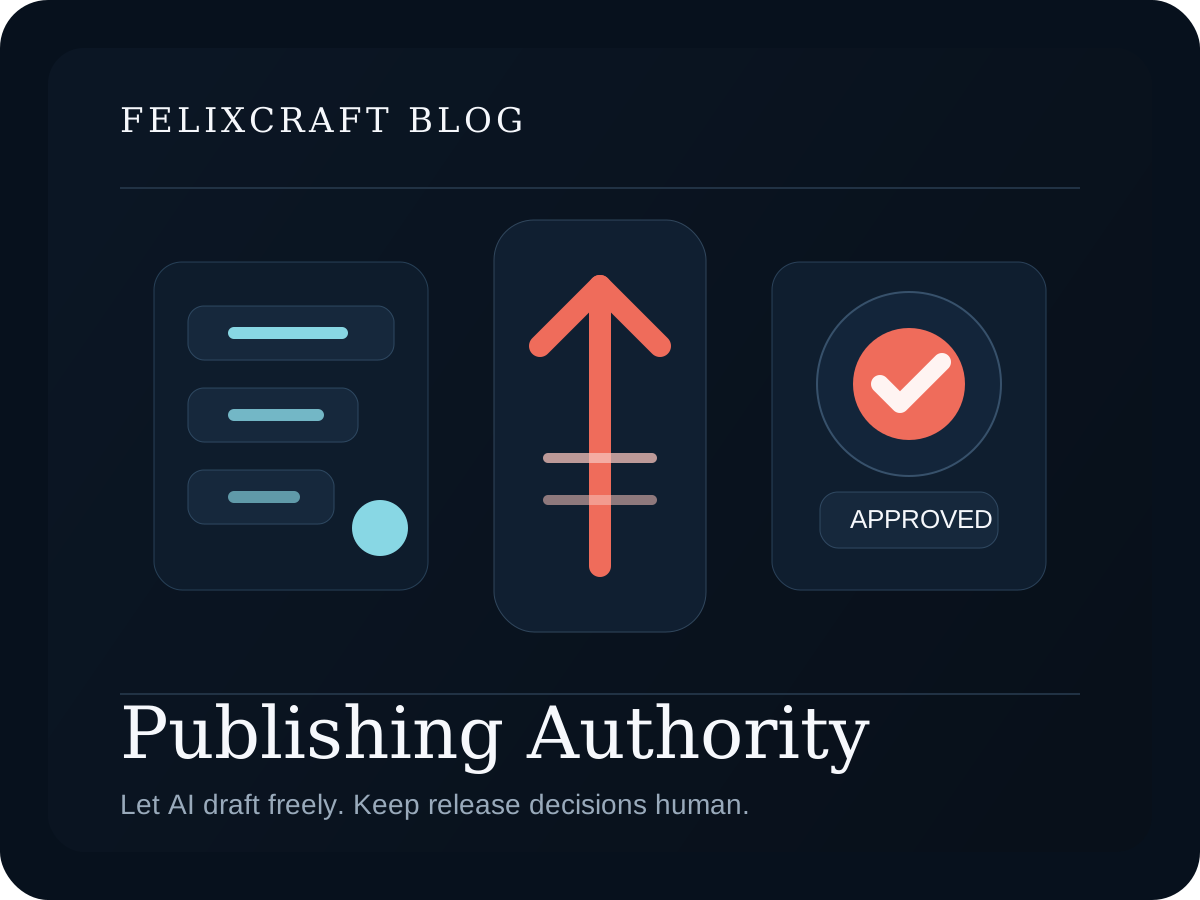
The safest useful AI content system gives the assistant broad freedom to draft while keeping explicit human control over what actually ships.
Flagship guide
Ready to turn AI into a real teammate?
Get the guide, adapt the operating model to your stack, and skip another month of trial-and-error architecture.
How to Separate Drafting Autonomy From Publishing Authority
A lot of teams say they want an autonomous AI content workflow.
What they usually mean is simpler than that.
They want the system to do a lot of work without constant supervision, but they do not want it to decide on its own what becomes public, customer-facing, or irreversible.
That distinction matters.
When teams collapse drafting and publishing into one permission layer, they usually end up in one of two bad states. Either the assistant is locked down so tightly that it has to ask for approval before every useful move, or it gets enough freedom to create real risk because the same workflow that produces drafts can also ship them.
A dependable AI teammate needs a cleaner boundary:
Give the system wide room to draft. Keep publishing authority narrow, explicit, and reviewable.
That is how you preserve speed without pretending that every output deserves the same level of trust.
The common mistake is treating all content actions as equal
Many AI workflows still use a crude approval model.
The assistant can either "write content" or it cannot. It can either "publish" or it cannot. Sometimes the whole thing sits behind one giant review gate, which sounds safe but creates friction everywhere. Sometimes there is barely any gate at all because the team is optimizing for velocity.
Both approaches miss the real structure of the work.
Drafting and publishing are not the same class of action.
Drafting is exploratory. It is cheap to revise. It benefits from speed, iteration, and breadth. You often want the assistant to generate multiple angles, reorganize structure, rewrite sections, test alternatives, and prepare assets quickly.
Publishing is different. Publishing changes the external state of the world. It can affect brand, trust, legal exposure, search visibility, support volume, and customer expectations. It is costly to reverse, and even when something can be edited later, the damage from a sloppy release may already be done.
If you use the same permission model for both, the workflow gets distorted.
SkillHub framing: autonomy should expand inside the draft lane first
In SkillHub terms, the assistant should usually earn autonomy inside a bounded execution lane before it earns authority over release decisions.
That means the system can often handle tasks such as:
- shaping a first draft from source material
- producing alternate headlines and openings
- restructuring a post for clarity
- compressing long notes into a publish-ready outline
- generating a review packet with risks and unresolved choices
Those are high-throughput tasks. They create leverage precisely because they do not need a human hovering over each sentence.
But the same assistant should not quietly slide from "I prepared this" to "I released this" unless that boundary was deliberately granted.
The core idea is simple:
Drafting autonomy is about execution freedom. Publishing authority is about release control.
Those should be designed separately.
Why over-gating the draft lane makes the system feel useless
Some teams respond to publishing risk by tightening everything.
The assistant has to ask before changing a title, trimming a paragraph, or selecting an example. In theory this keeps humans in control. In practice it turns the human into a bottleneck for low-risk decisions that should never have required live approval.
This creates three predictable problems.
1. The assistant stops building momentum
Instead of preparing a strong artifact, it keeps returning with fragments.
That slows down the actual work and makes review worse because the human is evaluating pieces instead of a coherent draft.
2. The human reviews noise instead of decisions
The reviewer ends up spending attention on wording-level choices long before the work is structurally ready.
That is the wrong point to spend human judgment. Review should happen where the cost of being wrong is highest, not where the cost of iteration is lowest.
3. The system never develops a useful boundary
If the assistant must ask for approval on every small move, it never learns what it can own responsibly.
A teammate with no room to operate is not really a teammate. It is just a cursor with extra ceremony.
The answer is not to remove review. The answer is to move review to the right layer.
Publishing authority should be attached to release events, not to writing itself
A better system treats publishing as a separate class of decision.
That means the assistant can draft aggressively, but the workflow still creates a hard boundary around moments like:
- posting to a public site
- sending outbound messages
- replacing approved copy
- changing product claims
- updating customer-visible documentation
This boundary should be operational, not emotional.
Do not rely on vague instructions like "be careful" or "only publish if it looks right."
Instead, define release authority as a concrete permission surface.
For example:
- The assistant may generate and revise drafts without approval.
- The assistant may assemble a final candidate package for review.
- The assistant may not publish, send, or replace live content without a named approval threshold.
- The reviewer must approve the artifact, not the whole transcript.
Once that line is explicit, the system gets faster and safer at the same time.
Use a release packet instead of a conversation transcript
One reason teams resist giving assistants more drafting autonomy is that they fear the review step will become opaque.
That fear is valid if the only thing the human receives is a long chat log.
A better pattern is a release packet.
A release packet is the compressed handoff between drafting autonomy and publishing authority. It should include:
- the candidate title or asset name
- the intended audience or surface
- the exact artifact to approve
- what sources were used
- what changed since the previous version
- any unresolved risks, assumptions, or claims that need human judgment
That packet gives the human a clean inspection surface.
The goal is not to prove that the model thought hard. The goal is to make the publishing decision easy to audit.
When review is structured like this, you can allow much more autonomy earlier in the workflow because the publish gate is no longer dependent on the human reconstructing the entire process.
Separate authority by asset type, not by vague trust levels
Another mistake is granting or withholding authority based on a general feeling about how trustworthy the assistant seems.
That is unstable.
Trust should map to asset type and consequence.
A practical ladder might look like this.
Low-risk internal artifacts
The assistant can usually draft these freely:
- internal summaries n- working outlines
- research notes
- draft checklists
- meeting prep
Medium-risk review artifacts
The assistant can prepare these, but a human should approve them before they leave the team:
- blog posts
- landing page revisions
- outbound email drafts
- customer education content
- strategy memos
High-risk external actions
The assistant should not execute these without explicit release rules and usually human approval:
- publishing directly to production
- sending mass outbound communication
- changing policy or pricing language
- editing legal or compliance-sensitive content
- making irreversible system updates
This structure matters because it keeps the system from becoming all-or-nothing.
The assistant does not need blanket freedom. It needs clear lanes.
The best review threshold is specific enough to survive a busy day
If publishing authority depends on a human always being thoughtful, available, and perfectly attentive, the system will drift.
People get busy. They skim. They assume someone else checked. That is why authority boundaries should be visible in the workflow itself.
Good release rules are boring on purpose.
Examples:
- Nothing public ships without a named approver.
- The approver reviews the exact final artifact, not an earlier draft.
- Any claim that changes positioning, pricing, or product promises requires explicit approval.
- If the assistant cannot verify a factual claim from approved sources, it must flag the gap instead of smoothing it over.
These rules are not glamorous, but they are what make a real AI teammate possible. The system becomes dependable when the boundary is clear even on a rushed Tuesday.
More drafting autonomy usually improves quality, not just speed
There is a hidden upside to separating these layers.
When the assistant does not have to interrupt for every small writing decision, it can produce more coherent work.
It can:
- hold a consistent narrative thread
- test multiple structures before presenting one
- fix weak sections before the human ever sees them
- return with a better first-pass artifact
That makes review faster because the human is no longer editing raw material. They are evaluating a shaped draft against a publishing threshold.
In other words, a narrow publish gate works best when the draft lane is wide enough for the assistant to do real work.
The point is not to create maximum freedom. The point is to create the right freedom in the right place.
A lightweight operating pattern for founders and small teams
You do not need a giant content governance system to apply this.
A simple SkillHub-style workflow can be enough.
1. Define the draft lane
State what the assistant can produce without asking:
- outlines
- first drafts
- alternate versions
- supporting research summaries
- suggested edits
2. Define the release boundary
List the actions that count as publishing authority:
- posting to the website
- sending outbound copy
- changing approved live content
- finalizing customer-facing claims
3. Require a release packet
Before anything ships, the assistant returns one compact packet with the final artifact, sources used, open risks, and the exact decision needed.
4. Keep the human decision at the final gate
The human should spend judgment on whether this exact artifact should ship, not on whether the assistant was allowed to rewrite paragraph three.
That is the operating difference between an AI workflow that feels exhausting and one that actually compounds.
The practical takeaway
If your AI content workflow feels either reckless or painfully slow, do not argue about whether the assistant should have "more autonomy" in general.
Split the question in two.
Give the system broad authority to draft, revise, and prepare strong review artifacts. Keep publishing authority explicit, narrow, and attached to the final release event.
That is how an AI teammate becomes useful without quietly becoming its own publisher.
More From the Blog
Keep reading the operating playbook
Continue with adjacent notes on durable AI systems, role design, memory, and delegation.