A Memory System That Survives Daily Use
What to remember, what to forget, and how to stop AI context from collapsing over time.
Flagship guide
Ready to turn AI into a real teammate?
Get the guide, adapt the operating model to your stack, and skip another month of trial-and-error architecture.
A Memory System That Survives Daily Use
The fastest way to make an AI system feel impressive is to give it a lot of context.
The fastest way to make that same system feel unusable is to keep dumping more context into the same place forever.
Teams often call this a context problem, but it is really a memory design problem. If everything is treated as equally important, nothing stays useful for long. The model loses the thread, repeats stale assumptions, and starts carrying baggage from work that should have been closed days ago.
Durable AI systems need a memory model that separates what is stable from what is temporary.
Memory should have layers
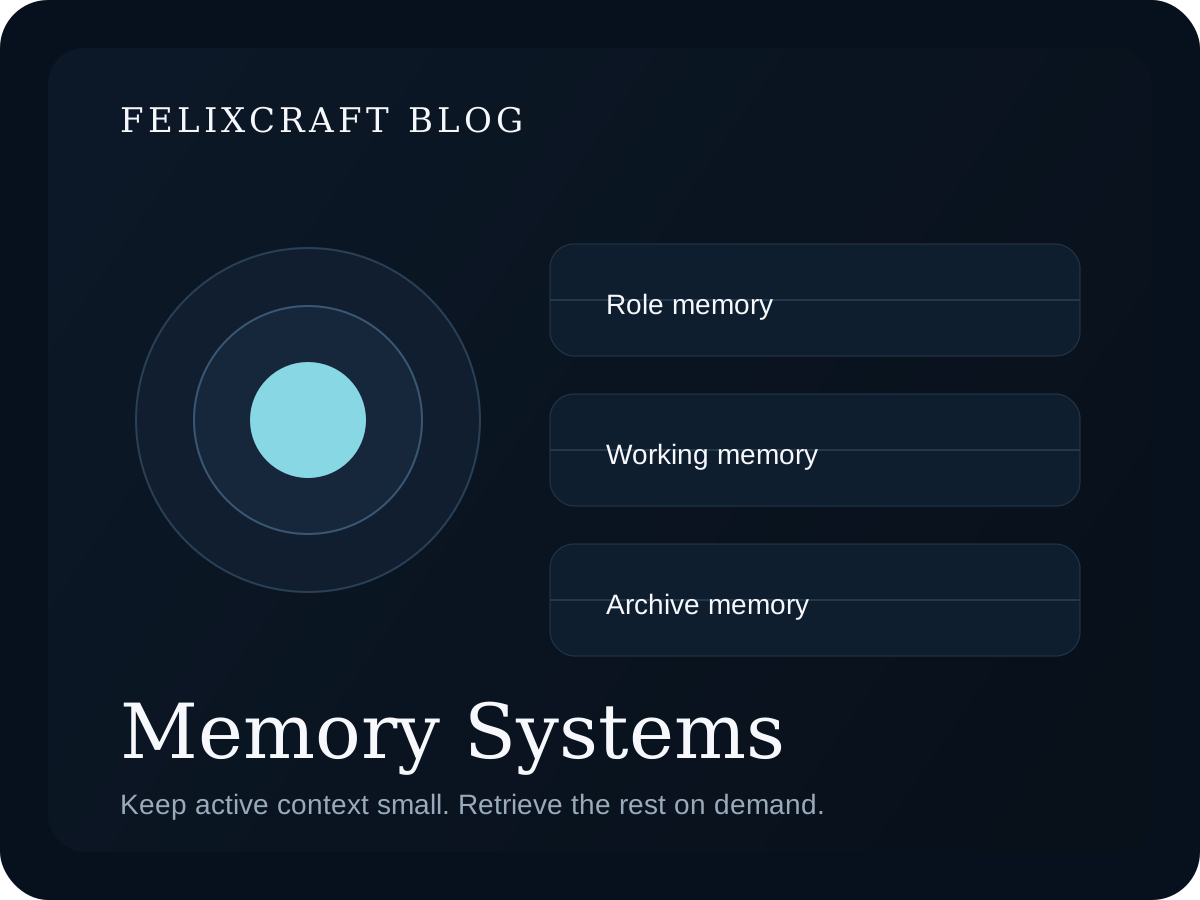
A practical system usually needs three layers:
1. Start with role memory
Role memory is the stable layer.
It answers questions like:
- What is this assistant responsible for?
- What standards should it follow?
- Which tools and sources are trusted?
- When should it escalate to a human?
This memory changes slowly. It is closer to operating policy than conversation history. If role memory keeps changing inside ad hoc chat threads, the assistant will feel inconsistent because its identity keeps drifting.
Store this layer as durable instructions or structured docs, not as something the model has to rediscover every time.
2. Add working memory
Working memory is the active task layer.
It captures:
- the current objective
- open loops
- recent decisions
- task-specific constraints
- the latest artifacts produced during the session
This is the layer most people actually mean when they say "context." It should be small, current, and aggressively edited. Working memory is not an archive. It is the minimum state required to keep moving without re-asking basic questions.
3. Keep archive memory separate
Archive memory stores history that may matter later but should not sit in the active context window all day.
Examples:
- prior campaign retrospectives
- closed decision logs
- previous draft iterations
- resolved customer requests
- old operating experiments
Archive memory should be searchable or retrievable, not permanently loaded.
That separation matters. A system becomes much more stable when the default state is "retrieve on demand" instead of "carry everything all the time."
Memory should earn its place
A good filter for any piece of information is:
Will the assistant fail on the current task if this is missing?
If the answer is no, it probably does not belong in working memory.
This rule forces discipline. Teams often retain context because it feels expensive to discard it. In practice, low-value context is expensive to keep. It makes reasoning slower, retrieval noisier, and outputs less coherent.
What to keep in working memory
Working memory should contain only the items that actively shape the next move.
Useful examples:
- the task owner and deadline
- the current version of the objective
- unresolved blockers
- key constraints from the latest review
- the exact output format expected next
Bad examples:
- every previous brainstorm
- resolved debates
- outdated specs
- old prompts that were replaced
- reference material that can be fetched from a source document
If an item was important yesterday but no longer changes the next decision, archive it.
Summaries are better than raw history
One of the most common mistakes in AI workflows is preserving raw conversation logs as memory.
Raw logs are noisy. They contain false starts, repeated phrasing, outdated hypotheses, and detail that only mattered in the moment. When the model sees that entire trail later, it treats the mess as signal.
Instead, convert history into summaries with clear sections:
- objective
- current state
- known constraints
- decisions made
- open questions
- next action
Summaries compress the work without throwing away meaning. They also give humans a much better place to inspect and correct the system.
Memory needs expiration rules
Every memory layer should have rules for when information gets refreshed, archived, or deleted.
Without expiration, memory quietly rots.
Useful expiration questions:
- Is this still true?
- Is this still active?
- Is this already reflected in a more stable document?
- Does this still change the next decision?
If the answer is no, remove it from the active layer.
This is especially important for AI teammates that operate over days or weeks. Long-running systems do not fail because they forget everything. They often fail because they remember too much of the wrong thing.
Memory is part of delegation
A strong memory system also improves delegation.
When a role can inherit stable memory and receive a compact working brief, you can spin up focused assistants without forcing each one to relearn the entire environment. That is what makes sub-agents viable. Each agent gets:
- a stable role
- a task-specific brief
- access to archives when needed
That is much better than giving every agent the same giant transcript and hoping they all extract the right meaning.
A simple operating pattern
If you want a lightweight implementation, start here:
- Put role memory in one durable source of truth.
- Maintain a short working brief for each active thread.
- Convert resolved work into structured summaries.
- Move old material into archive storage.
- Retrieve archives only when they are relevant to the current task.
That alone will outperform most "just keep the whole chat" systems.
The practical takeaway
Memory should not be a pile. It should be a system.
The goal is not to help the model remember everything. The goal is to help it remember the right thing at the right layer for the right amount of time.
When teams get this right, AI stops feeling like a fragile chat session and starts feeling like an operator that can pick up work where it left off.
More From the Blog
Keep reading the operating playbook
Continue with adjacent notes on durable AI systems, role design, memory, and delegation.